- hrtdmedicalinstitute.dhaka@gmail.com
- +88 01784-572173

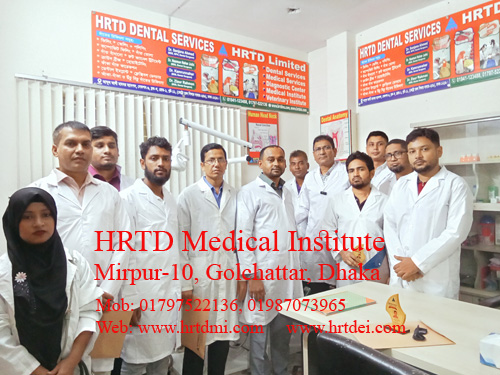
Diploma in Dental Technology
Diploma in Dental Technology 3 Years
Admission Fee Tk 20500/-
Monthly Tuition Fee Tk 3000/-
Total Course Fee Tk 152500/-
Total Subject: 24
Total Exam Marks 2400.
Subjects for Diploma in Dental Technology 3 Years:
1. Human Anatomy & Physiology
2. Pharmacology-1
3. First Aid & Study of OTC Drugs
4. Anatomy of the Head and Neck
5. Dental Anatomy & Physiology
6. Dental Disease & Treatment
7. Dental Surgery-1
8. Microbiology & Antimicrobial Drugs
9. Dental Material
10. Dental Pathology
Dental Anatomy


View all
The anatomy of a tooth includes the crown (the visible part above the gums), the neck (the middle section at the gumline), and the root (the part below the gums that anchors the tooth). The main layers are enamel (the hard outer layer), dentin (the bulk of the tooth beneath the enamel), and pulp (the inner soft tissue with nerves and blood vessels).
Parts of the tooth
- Crown: The visible part of the tooth above the gumline, covered in enamel.
- Neck: The narrow part of the tooth at the gumline, where the crown meets the root.
- Root: The part embedded in the jawbone that anchors the tooth. It is covered by cementum and contains the root canal.
Layers of the tooth
- Cementum: A bone-like layer that covers the root of the tooth, helping to anchor it to the jaw.
- Enamel: The extremely hard, protective outer layer of the crown.
- Dentin: The layer beneath the enamel that makes up the main body of the tooth.
- Pulp: The innermost part of the tooth, containing nerves, blood vessels, and connective tissue. It extends from the crown's pulp chamber to the tip of the root via the root canal.
Types of teeth
- Incisors: The front teeth used for biting.
- Canines: The pointed teeth next to the incisors, used for tearing food.
- Premolars (or bicuspids): Teeth located behind the canines that are used for grinding and crushing food.
- Molars: The large teeth at the back of the mouth are used for heavy grinding and crushing.